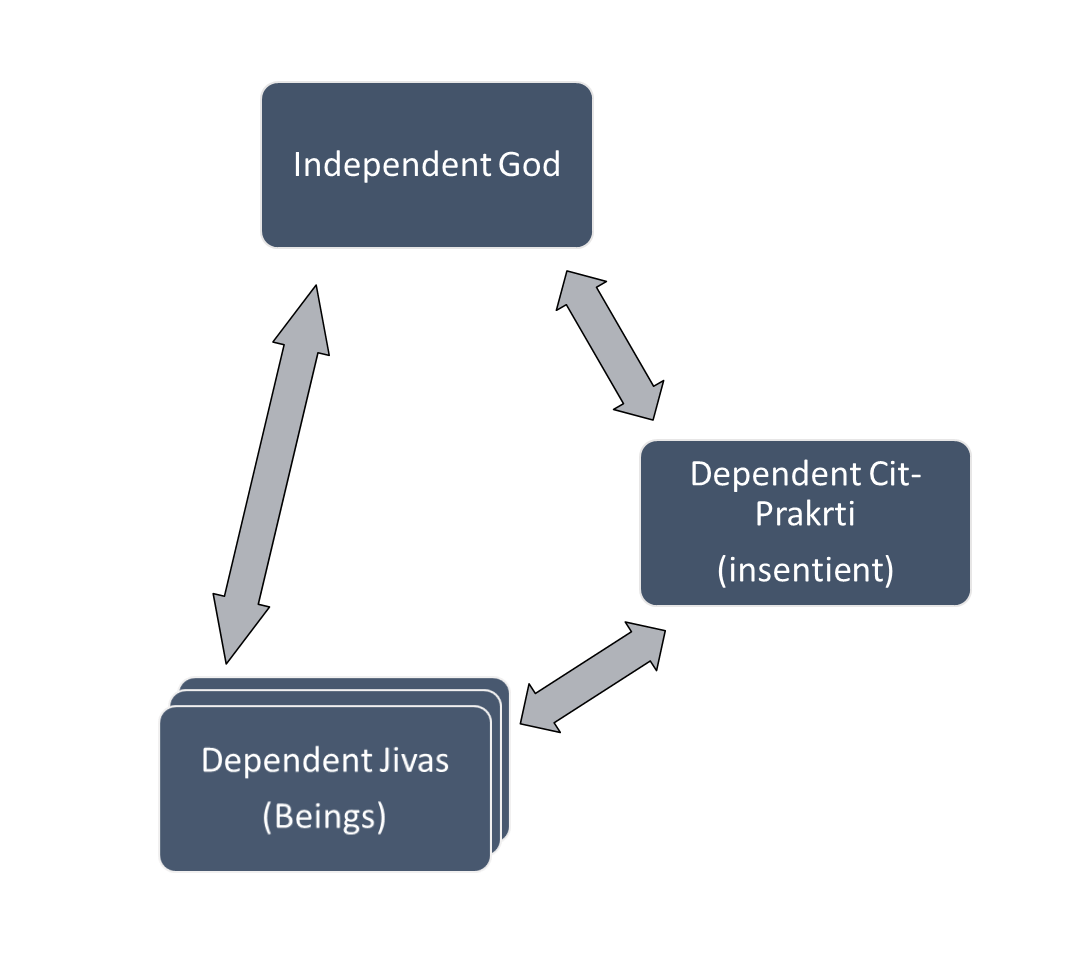
It re-establishes God with auspicious attributes as the supreme all pervading, all powerful, essence of the universe. Under God’s direction Cit-Prakriti (the spirit behind the primordial matter), undertakes creation, sustenance, and dissolution of the universe. Creation is a benevolent act performed for the sake of innumerable bound Jivas (beings) to provide the required experience, so that they acquire knowledge and get liberated. The God, the Cit-prakrti, and innumerable Jivas are all eternal entities with neither beginning nor end. The sentients are reflected images of God, similar in nature to God, though dependent on God. They are experiencing misery due to their assumed independence. Elimination of this ignorance results in liberation. The state of liberation is not only devoid of all misery, but also is a positive state of bliss (ananda) experienced by each being according to its capacity.
The path advocated for liberation is Karma Yōga, Jnana Yōga and Bhakti Yōga operating in sync .
Practice of Karma-Yōga means proactive performance of one's own duty (swa-dharma) based on his position in the society, without expecting any reward. It results in knowledge. As this knowledge deepenes it provides insight into the working of the inner mind, as well as that of the external world. This is 'Jnana-Yōga'. Such a knowledge results in realisation of the dependent nature of human endeavours and independent supremacy of the Lord, Iswara. It results in devotion to the God where being surrenders to the supreme God and continues performing swa-dharma in the world as a worship. This is 'Bhakti-Yōga'. This spiralling process of action, knowledge, and devotion progressively results in elimination of all past defective imprints, grace of the God, and finally jeevan-mukti, the liberation.
Following hymn composed by Madhvacharya as an opening remark in his commentary on the Mahabharata provides this insight.
नारायणाय परिपूर्णगुणार्णवाय विश्वोदयस्थितिलयोन्नियति प्रदाय।
ज्ञानप्रदाय विबुधासुरसौख्यदुःखसत्कारणाय वितताय नमो नमस्ते ।।
The all pervading one is complete with auspicious qualities and governs the evolution, sustenance and dissolution of the universe. He gives knowledge by giving happiness to the good, pleasure to the mixed, and misery to the demoniacal as per their deeds (sat-karana). I salute such an auspicious one.
Here the word sat-karana is specifically used to indicate alignment of the tatva-vāda doctrine to other vedic darshanas like Sānkhya, Nyāya and Yōga which also advocate satkarya-vāda. Satkarya-vāda in essence advocates - "the potential of the effect is already present in the cause". Seed is the potential while tree is the effect. A specific seed results in a specific tree when conditions are ripe.
Madhva with his 'tatva-vāda' was only trying to re-establish the original position of the Vedānta as conceived by Badarayana Vyasa. A quick look at the other five classical darshanas (sankhya, yōga, nyāya, vaisheshika, and mimāmsa), the three āgamas (vishnu, shaiva, and shakta) and their metaphysical emphasis on realism and multiplicity of souls will point to this fact.