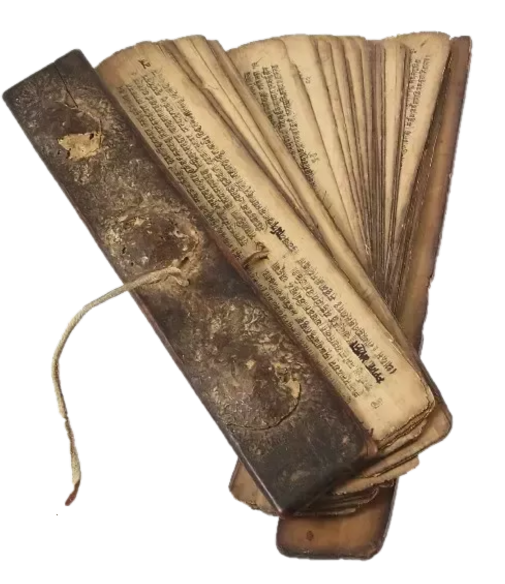
- ॥ हरिः ॐ ॥ (Lord Hari is only Ōm!)
- Māndukya 1.01
"Om" is the essence of everything. It encompasses the past, present, and future. Everything is indeed Om, and anything beyond these three times is also Om.
- Māndukya 1.02
All this is indeed Brahman. "This Ātmān is Brahman". This self has four aspects.
- Māndukya 1.03
In the waking state, the consciousness is directed outward, characterized by seven limbs and nineteen mouths, and it experiences the gross objects. The first form of the lord that giverns this is known as Vaiśvānara.
- Māndukya 1.04
In the state of dreams, the inner consciousness is seven-limbed, with nineteen mouths, enjoying subtle objects. The second aspect of the Lord during this process is known as 'taijasa', the luminous one.
- Māndukya 1.05
The state of sleep, where one does not desire anything nor sees any dreams, is called 'suṣupta', i.e. deep-sleep state. In that deep-sleep state the dense being that has become one is carried by the 'prajña', i.e. the wise form of the Lord, who is full of bliss, who is the experiencer of bliss without having the need for sense enjoyment, who has the face that is of the form of knowledge. This third aspect of the Lord is called 'Prājña', i.e. the wise one.
- Māndukya 1.06
This is the Lord of all, this is the omniscient, this is the inner controller. Indeed, this is the source of all, the origin and dissolution of beings.
- Māndukya 1.07
Here are these verses:
The all-pervading outwardly conscious in the form of 'Viśva', i.e. universal, is indeed also the inwardly conscious, called 'Taijasa' i.e. luminous, and in the form of 'Prājña', i.e. the wise one, carries the heavy and ignorant being; thus remembered to be three-fold.
- Māndukya 1.08
The universal aspect, 'Viśva', is situated in the right eye, the luminous aspect, 'Taijasa', in the mind, and the wise aspect, 'Prājña', is situated in the space within the heart, all threefold within the body.
- Māndukya 1.09
Understand, that he the Lord makes the being enjoy experience all the time in three ways: in the universal form, 'Viśva', consumes the gross, in the luminous form, 'Taijasa', consumes the subtle, and the wise one, 'Prājña', makes him experience bliss.
- Māndukya 1.10
The gross aspect satisfies the universal form, 'Viśva', while the dream state satisfies the luminous form, 'Taijasa', and the bliss satisfies the wise form, 'Prājña' - thus understand the threefold satisfaction.
- Māndukya 1.11
In the three realms, the proclaimed food and enjoyer, he who knows both, while partaking, remains untainted.
- Māndukya 1.12
The origin of all beings is certainly in the 'sat' — the good, the reality. The Supreme person individually creates all aspects of life and conscious beings.
- Māndukya 1.13 and 14
Some thinkers of creation consider 'vibhūti', i.e. the glory, as creation, while others consider it to be like a dream and illusion, while some others consider it as imagined. The creator, Lord Brahma, especially ascertain the creation to be merely the will of the Lord. Those who contemplate time think that the origin of all beings is from time.
- Māndukya 1.15
Some say creation is for enjoyment; others say it is for play. This is the nature of the divine; what desire can there be for one whose desires are already fulfilled? - stated thus.