...

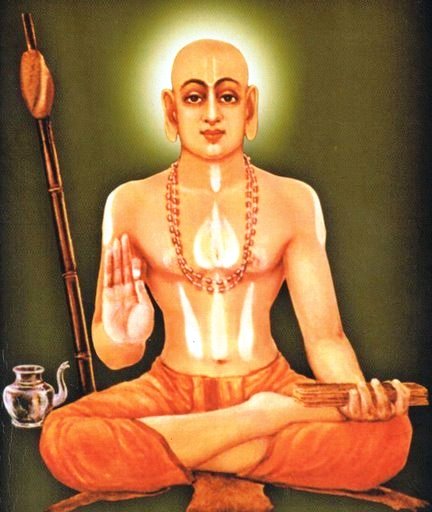
Madhvācārya was a thirteenth-century philosopher who systematized Dvaita Vedānta, a realist and theistic interpretation of Vedānta. His philosophical system is called Tattvavāda, the doctrine of reality or true principles. This website is dedicated to providing English translations of Madhvācārya's works, collectively known as the Sarvamūla. These include his commentaries on the Bhagavad Gītā, ten principal Upaniṣads, Brahmasūtras, Mahābhārata, Bhāgavata Purāṇa, and several other works.

Study Sarvamoola!


...

Tattvavāda — Realism of Vedānta

Madhva's philosophy can perhaps be understood most simply through the opening verse of his Mahābhāratatātparyanirṇaya:

नारायणाय परिपूर्णगुणार्णवाय विश्वोदयस्थितिलयोन्नियति प्रदाय।
ज्ञानप्रदाय विबुधासुरसौख्यदुःखसत्कारणाय वितताय नमो नमस्ते॥

"The all-pervading Lord Nārāyaṇa is complete with infinite auspicious qualities. He governs the creation, sustenance and dissolution of the universe. He grants knowledge through the appropriate experience of happiness and suffering. I offer my salutations again and again to such a Lord."

This single verse brings together much of Madhva's understanding of reality.

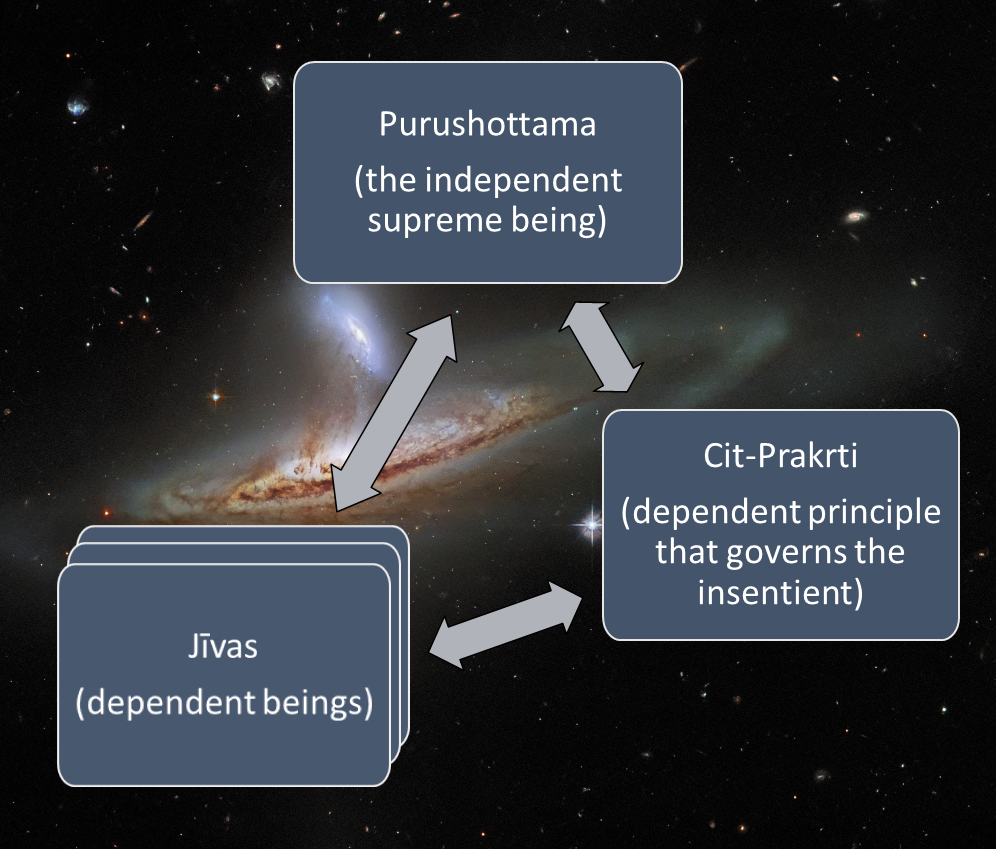
At the centre stands Nārāyaṇa, the all-knowing, all-powerful and all-pervading Supreme Being, complete with infinite auspicious qualities. He alone is independent. Everything else — individual souls, Prakṛti and the universe — is real, but exists eternally in dependence upon Him.

The individual souls are innumerable and eternal. Yet, being ignorant of their true nature, they fail to recognise their dependence upon the Supreme. They seek to control, possess and act as though they were independent. From this ignorance arise attachment, wrong action and suffering.

The material universe, however, is not an illusion. It is a real and purposeful creation. The Lord is perpetually engaged in its creation, sustenance and dissolution for the ultimate good of dependent beings. The universe provides the field in which souls act, experience the consequences of their actions, acquire knowledge and gradually move towards liberation.

Cit-Prakṛti, the conscious presiding principle over Prakṛti, functions within this divine order as the mother and governess of the material universe. She nurtures and guides dependent beings through their experiences, enabling their gradual movement from ignorance towards knowledge.

This gives happiness and suffering an important place in Madhva's understanding of existence. They are not merely random experiences. Madhva describes the Lord as jñānaprada — the giver of knowledge. Through the consequences of action, beings are gradually educated by experience. Benevolent action brings appropriate happiness, harmful action brings suffering, and through both the soul gains knowledge.

The world is therefore not something from which meaning has to be denied in order to attain liberation. It is the very field through which the individual learns the nature of reality.

The journey is from ignorance towards increasingly deeper awareness: to recognise oneself as eternal, to understand one's complete dependence upon the Supreme, to recognise His presence and governance everywhere, and ultimately to know one's true relationship with Him.

This is the realist foundation of Madhva's Tattvavāda. The Lord is real. Individual souls are real. Prakṛti and the universe are real. Difference is real. Action and its consequences are real. Suffering is real, but so is the possibility of knowledge and liberation.

Madhva understood Bādarāyaṇa Vyāsa's Vedānta Sūtras as establishing this realist and theistic understanding of the Vedic tradition. In this respect, his interpretation preserves important continuities with the other ancient Vedic darśanas — Sāṅkhya, Yoga, Nyāya, Vaiśeṣika and Pūrva-Mīmāṃsā — which, despite their considerable differences, broadly affirm the reality of the world, individual selves, causation, knowledge and action rather than reducing experienced plurality to an ultimately unreal appearance.

Madhva's Tattvavāda brings these realist commitments within a comprehensive theistic framework in which Viṣṇu is the one independent reality, while individual souls, matter and the entire universe are real but eternally dependent upon Him. Seen in this way, Madhva's interpretation of Vedānta is not an isolated philosophical construction, but a continuation and culmination of the broader realist orientation visible across the ancient Vedic philosophical tradition.

...

The Path of Swa-dharma and Knowledge Leading to Devotion

If ignorance of our dependent nature lies at the root of bondage and suffering, Madhva's solution is equally practical: acquire true knowledge, live according to one's swa-dharma, and allow that knowledge and right action to mature into devotion to the Supreme.

The first step is to recognise one's true condition. The individual is eternal, but not independent. Whatever capacities, opportunities and experiences one possesses exist within a larger order sustained by the Supreme. Recognition of this dependence changes the purpose of action. Instead of acting merely to possess, control or enjoy, one begins to act as service.

Madhva gives an important place to swa-dharma — the duty appropriate to one's own nature, disposition and circumstances. One need not abandon ordinary life to pursue liberation. Rather, one must understand one's place within the world and contribute through the work appropriate to one's own nature, dedicating that action to Janārdhana, the protector of all beings.

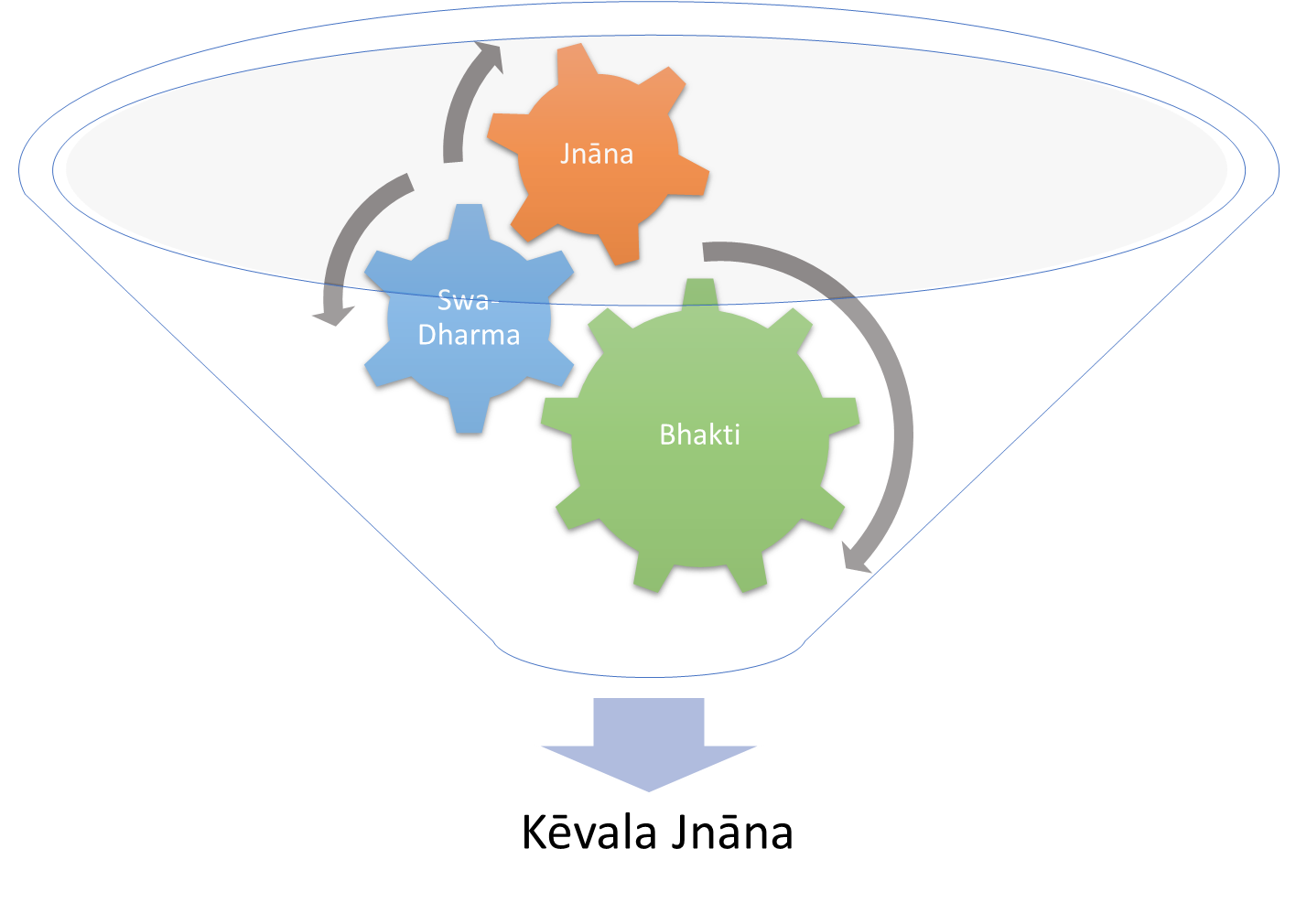
Bhakti inspires the performance of swa-dharma, while the proper performance of swa-dharma produces greater knowledge. That knowledge in turn deepens bhakti. Knowledge, devotion and action therefore reinforce one another, gradually transforming the individual's understanding and orientation.

Madhva expresses the indispensability of devotion through a striking analogy:

बाहुभ्यां सागरं तर्तुं क इच्छेत पुमान् भुवि।
वासुदेवमनाराध्य को मोक्षं गन्तुमिच्छति ॥

"Who would attempt to cross the ocean merely with his arms? How can one seek liberation without worshipping Lord Vāsudeva?"

— Kṛṣṇāmṛtamahārṇava 35

Knowledge alone is therefore not the final objective. As knowledge becomes deeper, the individual increasingly understands the infinite greatness and benevolence of the Lord and his own complete dependence upon Him. This gives rise naturally to devotion.

And Madhva makes this devotion remarkably simple and immediate:

हे जिह्वे मम निस्नेहे हरिं किं नानुभाषसे।
हरिं वदस्व कल्याणि संसारोदधिनौर्हरिः ॥७१॥

"O my indifferent tongue! Why do you not speak the name of Hari? Speak of Hari, O blessed one, for Hari is the boat by which this ocean of worldly existence is crossed."

— Kṛṣṇāmṛtamahārṇava 71

Remembrance of Hari, worship, performance of one's duties and acquisition of knowledge are therefore not separate paths. Each strengthens the other. Swa-dharma performed with the proper understanding produces knowledge; knowledge reveals more clearly one's dependence upon the Lord; this knowledge deepens bhakti; and bhakti further purifies and directs action.

This spiralling movement ultimately leads towards kevala-jñāna — the direct and complete knowledge necessary for liberation.

Madhva's understanding of the universe also allows ordinary life itself to become a means of approaching the Supreme. He expresses this through an important principle in the Gītā Tātparya:

सर्वैः क्रियापदैश्चैव सर्वेः द्रव्यपदैरपि।
सर्वैः गुणपदैश्चैव वाच्य एको हरिः स्वयम्।

"All words denoting actions, all words denoting substances, and all words denoting qualities primarily convey Hari."

— Gītā Tātparya 2.18

The implication is profound. The path to the Supreme does not require one to reject the world as unreal. The actions, objects and qualities encountered in the world can themselves become means of understanding the Lord when perceived correctly.

The solution Madhva offers is therefore not escape from reality, but correct knowledge of reality and correct participation in it.

Recognise one's dependent nature. Perform one's swa-dharma. Learn through action and experience. Allow knowledge to deepen into devotion. Direct both knowledge and action towards Hari.

Through this progressive movement from swa-dharma to knowledge, from knowledge to bhakti, and from bhakti towards direct knowledge, the individual moves from ignorance and suffering towards liberation and the experience of bliss.